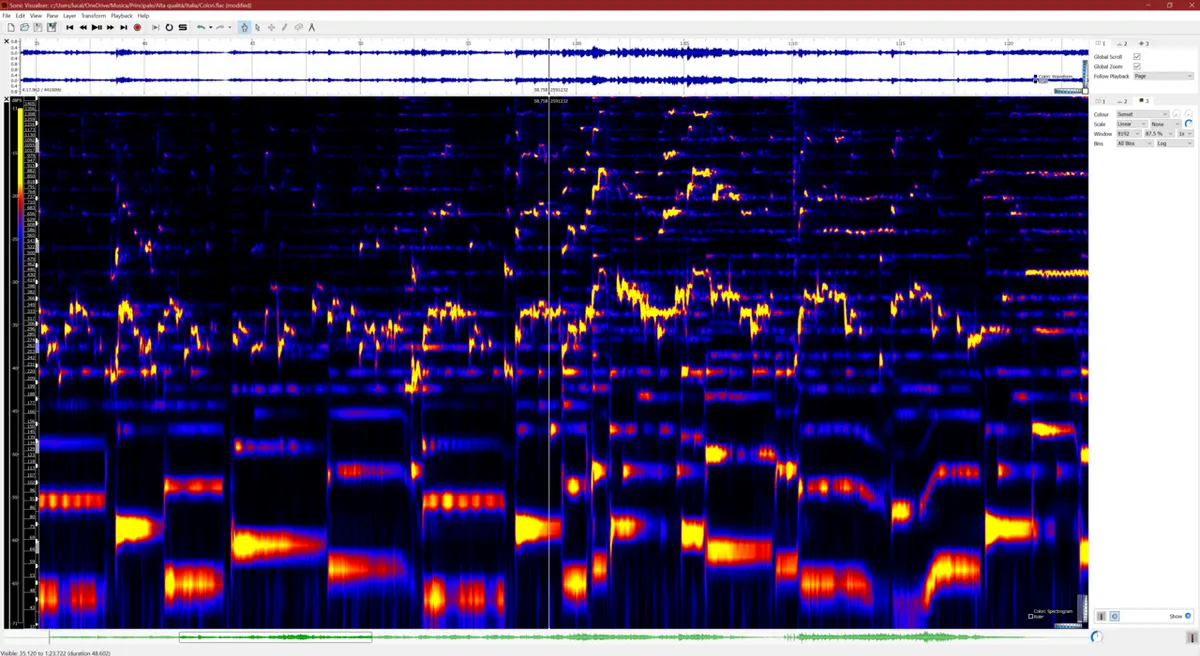
Play an old CD and a new one back to back and the new one is far louder. Put their waveforms side by side and the new one is a solid block, filled from top to bottom.
That race to be louder is called the loudness war. In one line: records kept shaving down the difference between loud and quiet and raising the whole track, to sound louder than everything else.
Why louder seemed to win
Hearing has a bias: play the same song slightly louder and it tends to sound “better”. The lows and highs come through more and it feels more powerful.
- In a CD changer or on the radio, the quieter track stands out. Nobody wanted to be the quiet one.
- A CD has a hard ceiling (0 dBFS). With the same ceiling for everyone, the only way to sound louder is to hold the peaks down and raise the average.
- The tools made it possible. From the mid-1990s, digital limiters that look ahead and catch peaks (sold as maximizers) came into wide use.
How much louder
Rock CDs in the 1980s are reported to have averaged around −17 dBFS. Oasis’s (What’s the Story) Morning Glory? in 1995 had many tracks averaging about −8 dBFS, exceptionally loud for its time. Same ceiling, an average close to 9 dB higher.
Raise the average and the gap between loud and quiet (the dynamics) shrinks. The thump of the kick, the lift as the chorus arrives, the breath in a quiet passage: loudness was bought with the song’s movement.
A famous case: Metallica’s Death Magnetic
Metallica’s 2008 album Death Magnetic is often held up as the symbol of the loudness war. Fans compared the CD with the versions of the same songs in the game Guitar Hero and found the CD far louder, and audibly more distorted.
A mastering engineer who compared them reported the CD as roughly 10 dB louder, and fans started a petition asking for a remaster. It was the moment many people learned that making a record louder can make it sound worse.
Louder does not mean it sells
The premise that louder sells was questioned too. A 2010 paper by Earl Vickers, presented at the Audio Engineering Society (AES) convention, questioned the assumption that loudness is strongly tied to listener preference and sales, and set out recommendations for de-escalating the race.
Heavily squashed audio may sound impressive for a moment, but it has also been linked to listening fatigue over longer periods.
What changed it: matching the volume
What actually turned things around was technology and regulation. A way of measuring loudness the way hearing works (LUFS) became an international standard, and broadcasters and streaming services began measuring each programme or track and playing them at matched volume.
| Year | What happened |
|---|---|
| Mid-1990s | Look-ahead digital limiters spread, making loud masters easy |
| 2008 | The sound of Metallica’s Death Magnetic becomes a news story |
| 2010 | The European Broadcasting Union issues R 128: normalise programmes to −23 LUFS |
| 2010 | The US CALM Act becomes law, requiring TV ads to follow a loudness practice (in force 2012) |
| 2011 | Japan adopts ARIB TR-B32, a loudness practice for digital TV |
| Since then | Streaming services play tracks at matched volume. Spotify says it uses −14 LUFS |
If the volume is matched, a track made louder simply gets turned down on playback. What is left is a flattened sound with its peaks and valleys shaved off. Next to a track that kept its dynamics, it loses on impact.
What it means when you make music now
- For streaming, start around −14 LUFS with true peak at −1 dBTP. Going louder gains almost nothing.
- Match the level before comparing with references. Louder sounding better is how hearing works, not a verdict on the mix.
- Watch the limiter’s gain reduction. If it stays at a few dB on the loudest moments, you are unlikely to be crushing it.
- Genre taste still counts. In EDM or metal, density is part of the sound. The point is to stop pushing to the maximum by default.

Summary
- The loudness war was the race to sound louder by shaving down dynamics and raising the whole track.
- The cost was movement, impact, and ease of listening.
- Once broadcast and streaming matched volume, pushing too loud lost its point.
- Today, start at −14 LUFS and −1 dBTP and keep the dynamics: that is what wins.
The tool for raising loudness is covered in what a maximizer is, and the whole finishing process in mastering basics. To measure your own track, Light mastering reports the LUFS and true peak measured from the exported audio.