The same song, played as a piano-only ballad, can sound like a completely different piece. You want to make arrangements like that yourself.
In one line, arranging is rebuilding everything around a song while keeping its core. Separating what the core is from what you can change keeps you from getting lost.
What to keep, what you can change
What makes a song recognisable is mainly its melody, its lyrics, and the broad shape of its chord progression. Keep those and you can change a great deal else while listeners still know the song.
| You can change | For example |
|---|---|
| Tempo and feel | A fast rock song becomes a slow ballad |
| Rhythm | A straight 8-beat becomes bossa nova or shuffle |
| Instrumentation | A band becomes piano and strings, or one guitar and voice |
| Key | Moved up or down to suit the singer |
| Chords (harmonisation) | Swap chords for others with the same role to change the colour |
| Structure | A new intro, an added interlude, a repeated last chorus |
The steps
- Take the original apart. Find the tempo and key (find the BPM and key), split it into parts, and listen to what each instrument is doing.
- Write out the skeleton. Just the melody and the chords, on paper or in software. This is what you will rebuild on.
- Name the direction in one line. Something like “a late-night ballad, just piano and cello”. Until you can say it in one line, it is easy to wander.
- Change one or two things at a time. Change tempo, rhythm, chords and instruments all at once and the original disappears.
- Give each instrument a role. Melody, harmony, rhythm, bass. Decide who covers what.
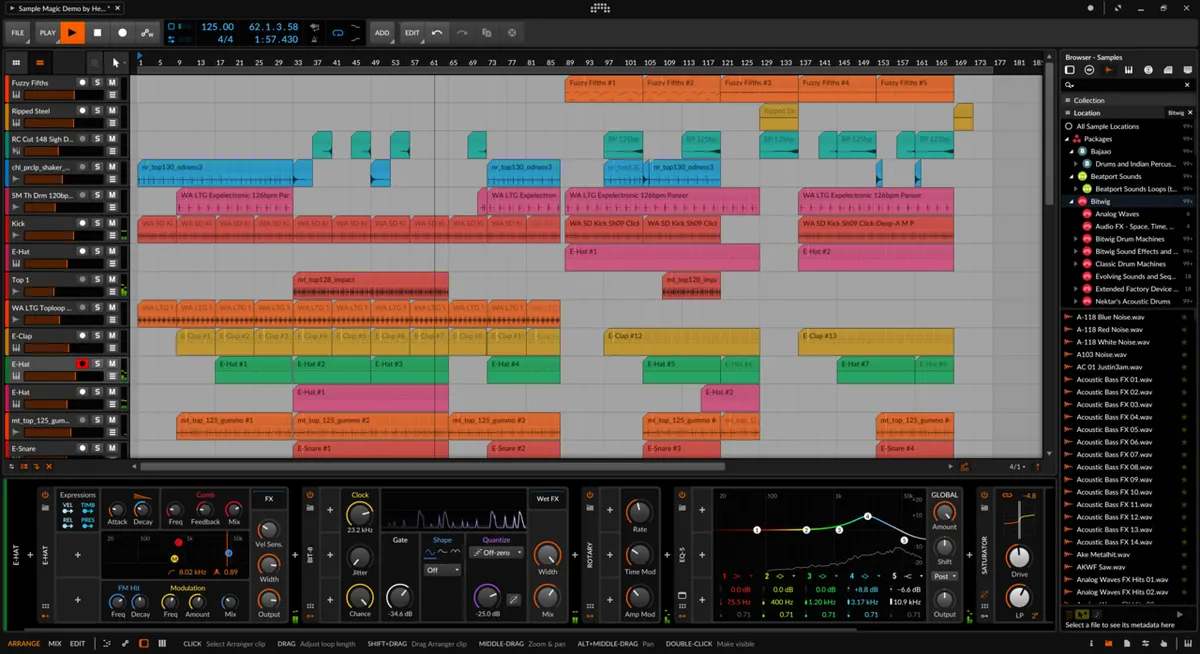
- Build the lift section by section. As in the figure below, add instruments as you head into the chorus.
- Compare with the original. Is it still recognisable? Does it have the character you aimed for?
Common techniques
- Slow it into a ballad. Not just slower: drop the drums, or halve the pattern, and it settles into a relaxed feel.
- Change the groove. The same chords as bossa nova, shuffle or waltz time change the mood completely.
- Use fewer instruments. Voice and guitar, or a single piano, put the words and melody right up front.
- Substitute chords. Chords with the same role swap easily. In C, try Am (vi) for C (I), or Dm (ii) for F (IV). Always check by ear that it doesn’t clash with the melody note.
- Modulate for the last chorus. Up a half or whole step brightens the ending.
- Write an intro. Playing a short phrase of the chorus melody on an instrument is the easiest way, and it introduces the song.
Give each part its own range
You layered instruments and it just sounds cluttered? The usual cause is several instruments moving in the same register.
- Roughly: bass down low, harmony in the middle, melody on top.
- If a chord instrument moves in the same range as the voice, move it an octave down or up.
- While the voice is singing, keep the backing’s busy parts quiet and move in the gaps between lines (call and response).
Publishing an arrangement needs permission
Arranging for your own enjoyment is up to you, but publishing an arrangement generally needs permission from the author (often the music publisher).
- JASRAC does not hold the right to permit arrangements. Video platforms’ blanket licences cover performing and singing songs, not permission to arrange them.
- In Japan, which publisher manages a song can be looked up in JASRAC’s work database (J-WID).
- Arrangements that change the lyrics or reshape the melody are especially sensitive, because they can clash with the author’s intent.
- Some authors and labels publish guidelines that allow arrangements or remixes. Looking for those first is the shortest route.
Summary
- Arranging means keeping the core (melody, lyrics, chord shape) and rebuilding the rest.
- Take the original apart, write out the skeleton, name the direction, and change one or two things first.
- Separate roles and ranges, and layer instruments by section to build shape.
- To publish, check you have permission to arrange.
To play your arrangement on video, see how to make a playing cover. For working with split stems, see stem separation for sampling and remixing.