AI music headlines are dominated by type-a-prompt-get-a-song services. For people who make music, that is far from the only use.
Turning a recorded guitar into a MIDI sketch, reading lyrics and chords, separating vocals from backing to edit one part — these shorten tedious steps rather than hand the song to AI.
In September 2026 Universal Audio announced LUNA 3.0, and Moises launched Moises Studio, a browser workspace for making music together. Both include AI, but they aim at different ways of working.
LUNA 3.0: production help built into the DAW
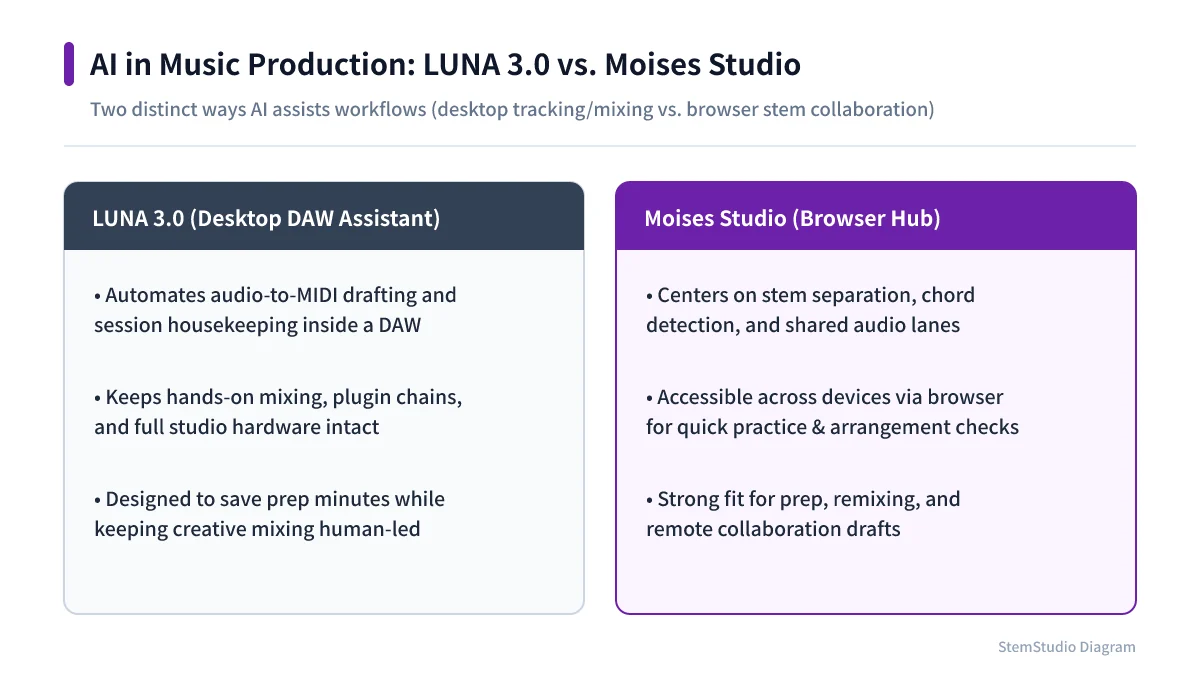
Announced on 15 September 2026, LUNA 3.0 adds LUNA Play (a recording mode that detects instruments, sets levels and suggests presets), stem separation, audio-to-MIDI, and lyric transcription and chord extraction powered by Moises.
What stands out is that these live inside the DAW rather than in a separate service. Analysis moves to where you record and edit, which may mean fewer trips to other sites mid-session.
| LUNA Free | LUNA Studio | |
|---|---|---|
| Price | Free | US$199, one-time |
| Platforms | macOS, Windows | macOS, Windows |
| Stem separation | 4 tracks | 6 tracks |
| Also includes | Unlimited tracks, piano roll, LUNA Play, Oxide Tape, eight UAD plug-ins and more | Everything in Free plus audio-to-MIDI, lyric transcription, chord extraction, tape and console extensions, UAD plug-ins and instruments |
Moises Studio: the browser as a shared room
Announced on 2 September 2026, Moises Studio combines multitrack recording, MIDI and AI tools in one shared browser session, so musicians in different places can record, arrange and edit together. Projects are shared by link and edited simultaneously, with comments on the timeline. Exports include mixes, stems, MIDI, MusicXML and DAWproject, leaving a route into other DAWs.
Moises stresses that its AI supports music artists are already making rather than generating finished songs: it suggests drum or bass parts that fit the key, tempo and instrumentation, which people then edit into the arrangement. AI output as material, not a finished product.
That also addresses a familiar band problem: files sent back and forth, versions crossing, nobody sure which is latest. A shared session could cut that down.
What the two have in common
LUNA brings AI into a traditional DAW; Moises brings production into a shared browser space. Both place AI as part of the workflow rather than a make-a-song button.
AI does not automatically make things faster. Separated audio can carry artefacts, audio-to-MIDI rarely yields usable performance data untouched, and chord extraction still needs a human on inversions, tensions and bass notes. Time spent checking, fixing and choosing remains.
With cloud services, also check browser support, connection needs, plans, how projects are stored and the terms for the material. They may not behave like a project file on your own disk.
What to look at when choosing a DAW now
Start from the work that eats your time rather than the feature count: interface compatibility if you mostly record, editing tools if you mostly program MIDI, sharing and versioning if you work as a band (which DAW is most used?).
For AI features, ask how far you can edit the results, whether you can get the source data out, and whether you can undo a bad result. Getting one rendered file is very different from getting stems or MIDI you can keep working on.
AI moving into the DAW does not simply remove the work of composers and players. It changes the steps of making, organising and converting material, and so changes where people spend their time. Judge new DAWs and AI features by whether they remove the tasks that actually slow you down.