Talk about mixing and EQ always comes up. But there are so many knobs that it is hard to know where to start.
In a phrase, EQ (equalizer) is a volume control for each range of pitch. Instead of raising or lowering everything, it raises or lowers just the low end, or just one part of the highs.
Frequency guide: what lives where
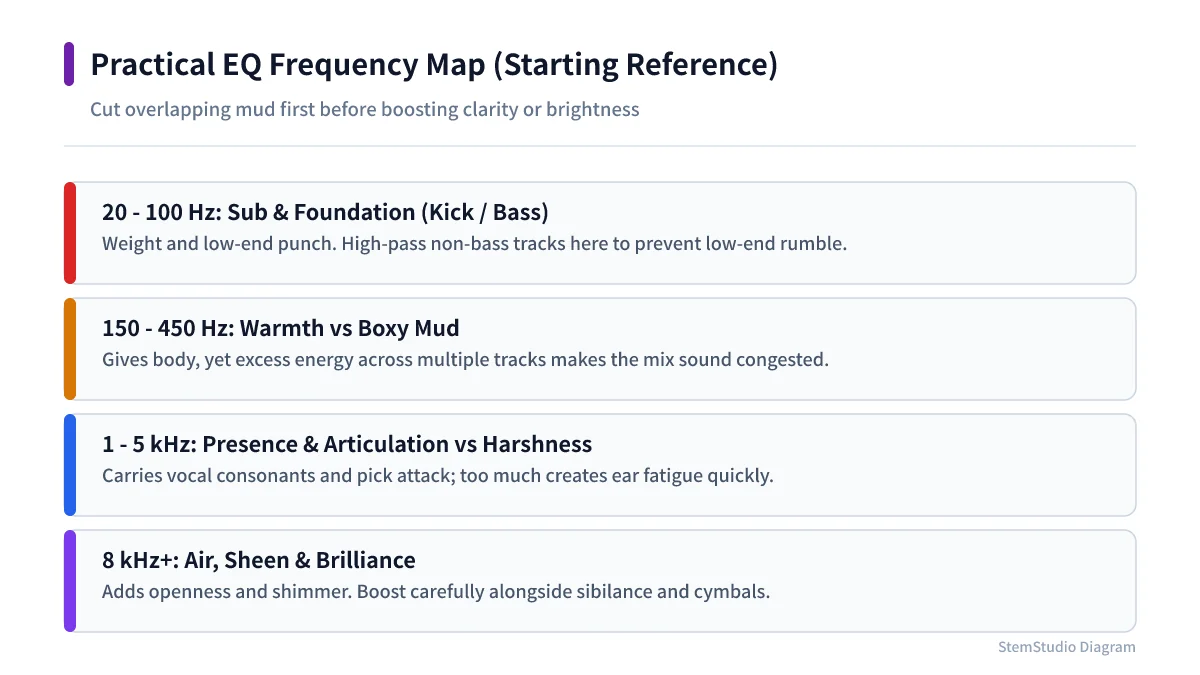
Pitch is measured in hertz (Hz): smaller numbers are lower, larger are higher. The table is a common mixing guide. Positions shift with each voice and instrument, so always confirm by ear.
| Range | Approx. | What you hear |
|---|---|---|
| Sub | below 60 Hz | Weight you feel. The bottom of kick and bass; too much makes everything vague |
| Low | 60–250 Hz | Body and size. Bass, kick, the base of a male voice |
| Low mids | 250–500 Hz | Where muddiness and boxiness build up |
| Mids | 500 Hz–2 kHz | The core: what makes a voice or instrument sound like itself |
| Upper mids | 2–5 kHz | Clarity and presence. Where hearing is most sensitive; too much hurts |
| Highs | 5–10 kHz | Sibilance (s and sh), cymbal shimmer |
| Air | above 10 kHz | Air and sheen; a little lift sounds brighter |
Cut before you boost
Once you start, it is tempting to raise what you want more of. Usually it works better to lower what is in the way.
- Boosting makes things louder, and louder is easily mistaken for better.
- In a mix of many parts, each giving way a little lets all of them be heard.
- Cutting never risks clipping.
Q is how much it takes with it
Most EQ bands have three controls: frequency, amount (dB) and Q. Q sets how wide a range around the frequency moves.
- High Q (narrow): pinpoint moves, for cutting a harsh peak or a particular ring.
- Low Q (wide): gentle, broad moves, for making the overall tone a little brighter or darker.
Remember “narrow to cut, wide to shape” and you will rarely go far wrong.
What to try first on a cover vocal
- Add a high-pass (low cut). Remove the very bottom the voice does not need (roughly below 80–100 Hz). Air-conditioning rumble and stand thumps disappear. For a deep voice, set it lower.
- Trim a little mud. Find where it sounds woolly around 250–500 Hz and lower it by just 2–3 dB.
- Look for harsh spots. A sharp peak can hide in 2–5 kHz. Finding harsh frequencies explains how.
- Finally, listen with the backing. A voice that sounds perfect solo can sound different in the mix. Always judge with everything playing.
Summary
- EQ is a volume control for each range of pitch.
- Lowering what is in the way usually beats boosting.
- Narrow to cut, wide to shape.
- Match levels when comparing, and make the final call with the backing.
Next: the compressor, which evens out level. Together with EQ, it is the foundation of mixing.